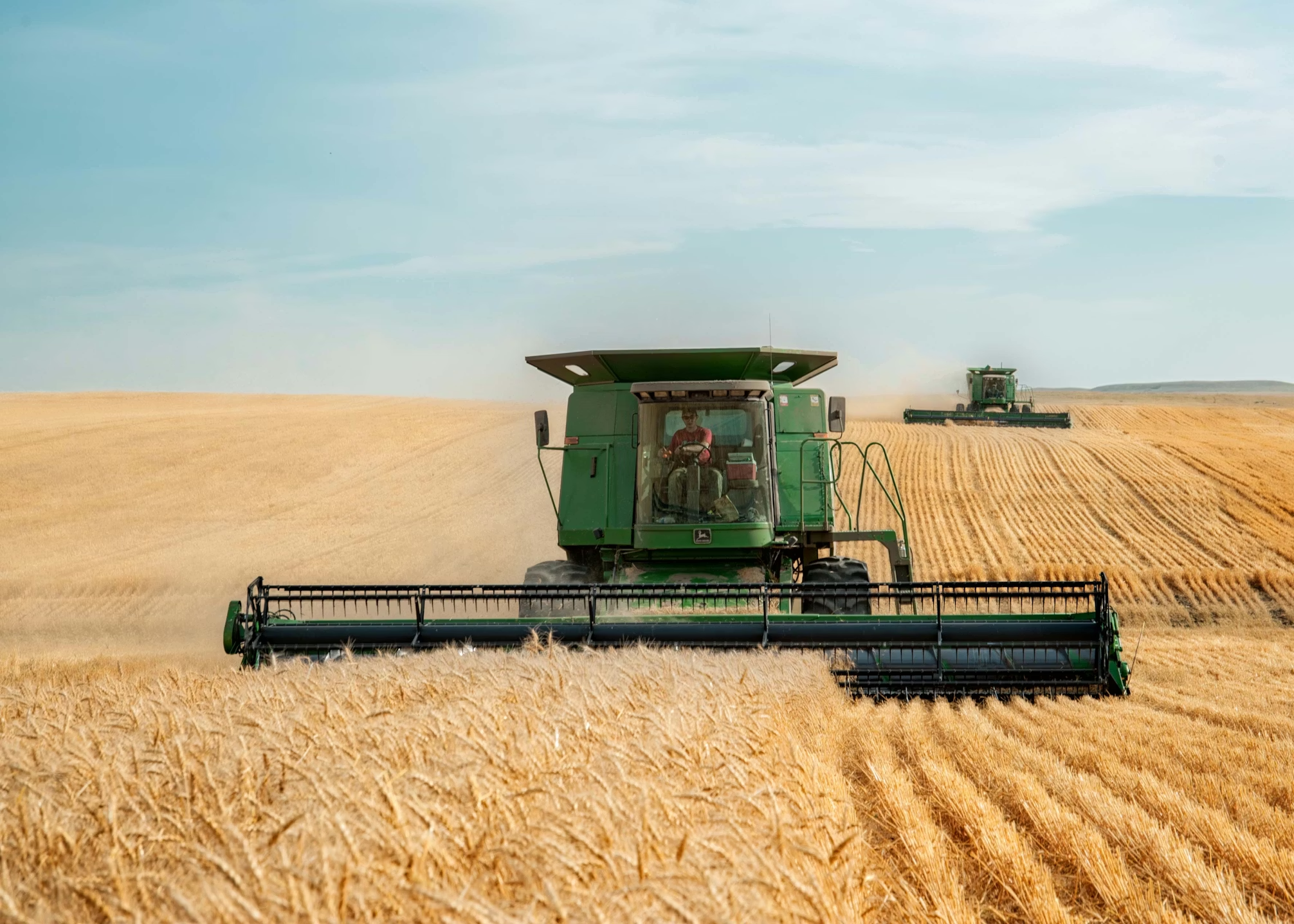
That divergence is now becoming structural. Farming is turning into a technology industry in the United States — data-driven, capital-intensive, increasingly automated. In Europe, it is being asked to do something different: to meet climate targets, preserve land, and sustain rural life. Both are deliberate choices — and they are leading to different outcomes.
American agriculture is built for productivity — and it is increasingly built like an industry. The United States produces more food, more efficiently, with fewer people than any other major agricultural economy. That is not an accident. It is the result of decades of technological progress, scale, and a system that rewards output.
Across much of Europe, the Common Agricultural Policy — decades of subsidy, regulation, and managed markets — has preserved rural life alongside production. Smaller farms survive. Villages remain intact. But many European farmers are now more dependent on Brussels than on their buyers, subsidized and constrained — as the protests spreading across France, Germany, and the Netherlands make clear. Both systems rely on government support. In Europe, it is a foundation of farm income. In the United States, it is still meant to be a backstop.
We have built a system that produces food at scale. We have not built one that produces opportunity at the same scale where that food is grown.
— Josh Dambacher
But the American model leaves something out.
Farm output has grown even as rural communities have declined. Fewer farms. Fewer people. Fewer reasons for the next generation to stay. In parts of the state, that shows up in school enrollments, in main streets, in whether the next generation comes back at all.
That's not an abstract problem. It's one I find myself thinking about more often.
Consolidation was the price of efficiency, and we paid it. The question now is whether we can build something back — not through subsidy or nostalgia, but through genuine economic development tied to what agriculture already produces.
As the legislative session closes and attention turns to what comes next, that question is no longer theoretical. The funding debate matters. But it is only part of a larger question: what kind of agricultural economy Kansas is trying to build.
That is the third path. Not European preservation. Not managed decline. Something the American model is well suited for: building new industries around existing strengths — and capturing value close to where it is created, rather than shipping raw output elsewhere.
Kansas has the pieces of this opportunity already in place. The question is whether it connects them — across regions, institutions, and policy. One of the world's leading concentrations of animal health companies runs through this state, with strength anchored in the Kansas City region. In 2023, the region received federal designation as a Tech Hub under the CHIPS and Science Act for advanced biologics and biomanufacturing — one of 31 regions chosen from nearly 400 applicants. That corridor is the starting point for a broader agricultural and life sciences economy. The chain — from what Kansas grows and raises to what it manufactures and innovates — is the real opportunity.
Other regions have already done this. North Carolina built the Research Triangle around its universities and agricultural base. Parts of Texas have done the same. Not through permanent subsidy, but through focused early investment that gave private capital somewhere to go — and then let it scale. The goal is not top-down development. It is creating the conditions that allow private capital and enterprise to do what they do best, and then get out of the way.
This will not bring every town back. It will not reverse decades of consolidation. But it can create new centers of gravity in rural and semi-rural Kansas — places where opportunity exists close enough to home that fewer people feel they have to leave.
American farmers don't need to become European farmers to survive. They need a rural economy that is as productive as they are. The farm policy debate has focused almost entirely on what happens on the field. The next phase needs to focus on what happens around it.
Because producing more was never the only point. It's to make sure there are still people — and communities — where that production happens.
The question now is whether we're willing to build an economy around agriculture that's as strong as agriculture itself.
Josh Dambacher is a fifth-generation Kansan, Managing Partner at a leading international law firm, and a regular commentator on American politics for the BBC, CNN International, and GB News. His writing has appeared in the Kansas City Star and the Wichita Eagle. He writes at The Plains Ledger.
— J.D.