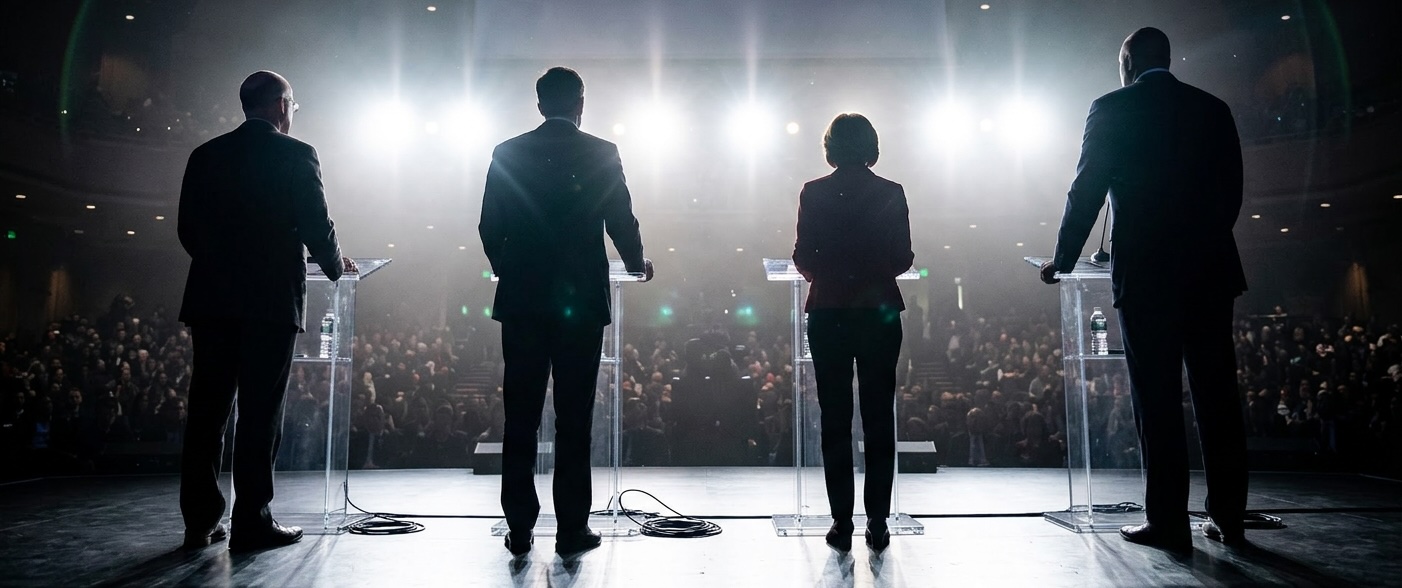
The thing most people will remember from Friday's Republican debate at Johnson County Community College is that Ty Masterson called Philip Sarnecki an angry elf.
That's the clip. That's what's already circling. I'd bet it's most of what survives from the whole evening — not a tax position, not a word about schools or water or property assessments, but the elf. I'm not above passing it along; I just did. It's a good line, and good lines travel.
Here's the part that got me, though. I went back and watched the full replay, because almost every write-up led with the elf and I wanted to see the moment that had apparently defined the night. And it's nothing. He nearly says it under his breath. As a piece of theater it's a throwaway — honestly close to the weakest thing he said all evening. Which left me with a small puzzle. The weakest, flattest line of the night is the one that became the night.
The weakest, flattest line of the night is the one that became the night.
— Josh Dambacher
Maybe that's just the press hunting through ninety minutes for the fifteen seconds that would travel, and conflict travels. Or maybe, just maybe, the line was planted and simply not delivered well. A man who knows what survives doesn't have to land it. He only has to say it once, on the record, and let the clip do the rest. I can't tell you which it was. I'm not sure it matters. Either way the elf ate the evening, and an evening's worth of everything else got buried.
That got me thinking about how little of a debate actually stays with us, and how rarely the part that stays is the part that should.
What I Remember from Wichita
Because I sat through one of these in person — the same governor's primary, back in January, in Wichita — and I can tell you what I remember, and it isn't anybody's policy. On the issues, honestly, most of them said close to the same things. If you handed me the transcript tomorrow I couldn't reliably tell you who said what.
Here's what I do remember.
Scott Schwab had lost his voice before the debate started. He was sick. And Charlotte O'Hara — standing near him, a rival, somebody with nothing to gain — quietly offered him a Kleenex. He turned her down. No camera was asking either of them to do what they did. It wasn't a moment anybody clipped. I only caught it because I was in the room. But I've thought about it more than almost anything any of them said that night. A debate is one of the few times you get to watch a candidate as a person instead of as a message.
A debate is one of the few times you get to watch a candidate as a person instead of as a message.
— Josh Dambacher
I remember Jeff Colyer, who was still in the race then, giving a little self-congratulatory nod after his own lines — then turning to wink at his cohort in the front row, the look of a man quietly pleased with how that one came out. I remember Masterson locked onto his theme, like a man who'd decided exactly what he was there to say and wasn't going to be moved off it — fighter, battle-tested, in the arena, the same beats every time. Whether that read as discipline or as a man on a loop depended, I suspect, on what you already thought of him. I remember Sarnecki sounding and carrying himself like a businessman rather than a politician, a different register from the others on stage around him — and to me probably more for the better than the worse.
None of that was on the transcript. You don't get it from a press release, and you really don't get it from a fifteen-second clip. You get it from watching a person operate unscripted in a room they don't fully control. Which, when you think about it, is most of the job of a governor.
The Fragment Problem
That's the part I keep coming back to. A debate rarely decides anything. But it's one of the few times you get to watch a candidate as a person instead of as a message — how they treat a rival who's struggling, what they do with a question they didn't want, whether they're listening or just waiting for their turn. Even the elf line tells you something — though probably not what the people sharing it think, and probably not as much as the moments it crowded out.
Most of what reaches me when I'm not looking is a fragment somebody else cut and shaped — the clip built to make me angry, the fifteen seconds edited to turn a stranger into a saint or a monster, or an elf. None of it is exactly false. It's just that a fragment held close to your face blocks out everything behind it. And there's never been more of it: I can pull up voting records, interviews, the whole debate, in minutes — more than my grandparents could have found in a lifetime. The information isn't the problem. My attention is.
Related Essay — Kansas Politics & Civics
Kansas Already Teaches Civics. That's Not the Argument.
On Governor Kelly's veto, what civic education actually requires, and why the data on younger Americans and political violence matters.
Read the essay →
What I've Settled For
So I've given up on the heroic version where I turn into a fully informed citizen with a binder. What I've got, on a good day, is a little discipline. I read past the headline to whatever it's standing on. I try to give the candidate I can't stand the same honest look as the one I like, which is harder than it sounds and which I don't always manage. The record is one piece. An endorsement is a piece — a heavy one in this race with, as Masterson told us at least six times in the debate, President Trump having weighed in. A debate is a piece. An angry-elf crack is a small piece, and a tissue offered to a rival is a bigger one than it looks. No single piece is the picture, and a picture's only worth something if I'm the one who put it together, instead of letting somebody hand it to me on a Facebook Reel.
No single piece is the picture, and a picture's only worth something if I'm the one who put it together.
— Josh Dambacher
The debate's over. The elf will do its work; somebody will tell you who won by the end of the week. I'd just as soon the clip not get the last word, because the last word is supposed to be mine — and yours.
I don't always manage it. But I sat in that room in Wichita, and I'm glad I did, and not for a single thing any of them said. I remember a woman offering a man a tissue. I remember him turning her down. It still seems like the truest thing that happened all night.
Josh Dambacher is the publisher of The Plains Ledger and a fifth-generation Kansan.
— J.D.