But here’s the part of the discussion that often gets overlooked.
Imagine two identical houses on the same block. One carries a $6,000 annual property-tax bill. The other carries $3,000.
Which one can a buyer afford to bid more for?
Most buyers don’t shop by sale price. They shop by monthly payment — mortgage, insurance, and taxes combined. Cut the tax line by $250 a month and a buyer has $250 a month of room to spend somewhere else in that budget: a bigger loan, a higher offer, or both. When enough buyers have that additional purchasing power, some of it can find its way into the price.
Economists have a name for this — capitalization — but the idea is ordinary enough: if owning a house gets cheaper, buyers can usually afford to bid more for one.
Where supply is tight and every listing draws multiple offers, more of that tax cut can be reflected in the sale price.
That’s why supply matters. Property-tax relief is justified. But without more supply, part of any property tax savings may simply become a higher purchase price.
For an existing homeowner, that’s welcome relief: the tax bill falls, and some of that relief may be reflected in the value of the house. But the calculation looks different for the family trying to buy its first one — a lower future tax bill, financed in part by a higher purchase price and a bigger down payment to get in the door.
Government spending matters, because ultimately local governments decide how much property-tax revenue to collect. But the other half of the equation is the value being taxed. Rising valuations don’t automatically require higher tax bills; local governments can lower their levies as values rise. When they don’t lower them enough, rapidly appreciating homes produce rapidly rising tax bills.
Most of the property-tax debate skips over a simple chain of cause and effect:
Housing supply influences home prices.
Home prices influence property valuations.
Property valuations influence property-tax bills.
Too much of the property-tax debate still tries to fix the last line first.
“Too much of the property-tax debate still tries to fix the last line first.”
— Josh Dambacher
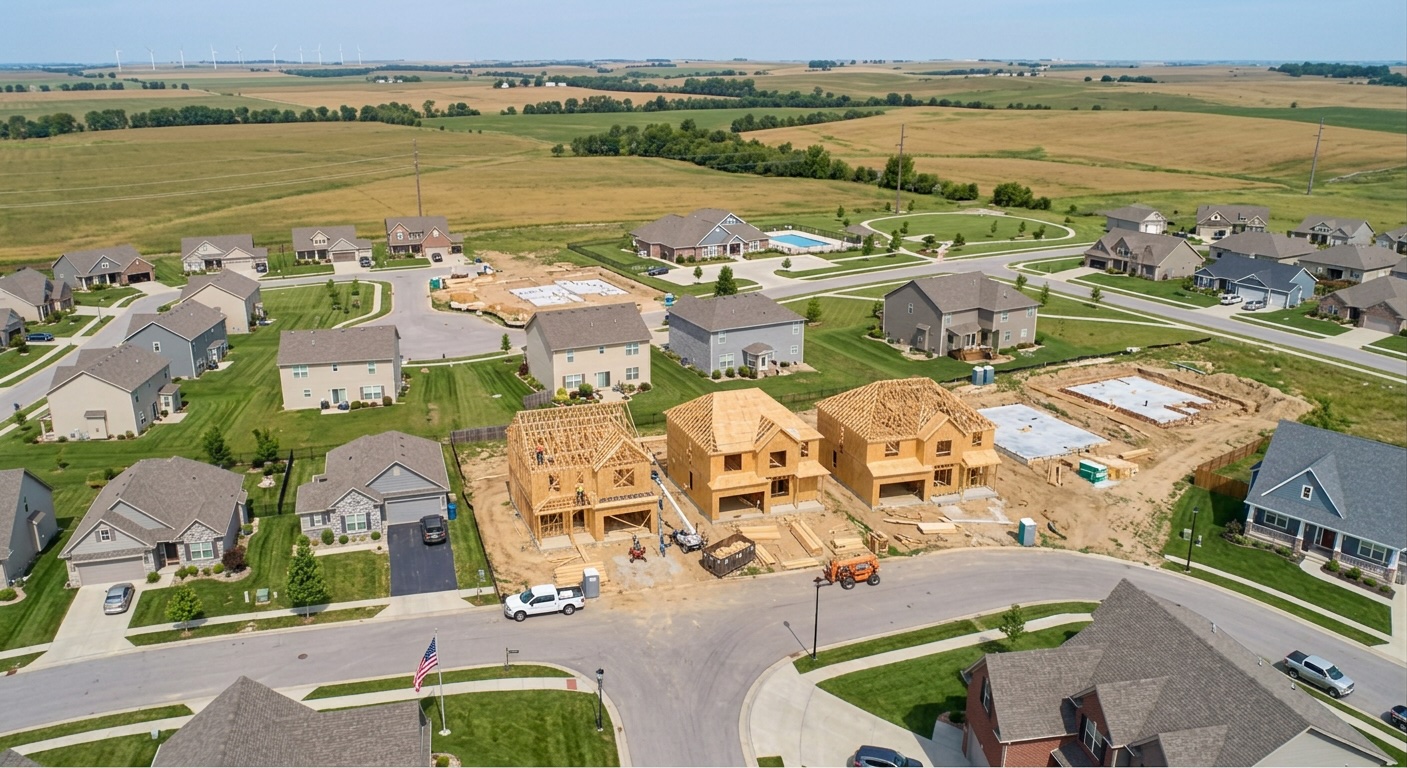
Kansas has been building too few homes for years, and the Kansas City region alone is estimated to be thousands of homes short of what buyers need.
Treat only that last link — cap the assessment, expand the exemption, cut the levy — and the first two links don’t move. The shortage remains, the pressure on home prices remains, and a few years later Kansas is having the same property-tax debate all over again.
Kansas doesn’t have a shortage of tax-relief plans. It has a shortage of houses — and the shortage isn’t the same shortage everywhere in the state.
Lawrence shows what happens when that imbalance persists. From 2018 to 2025, median home prices there rose 69 percent while median household incomes rose just 3 percent.
That isn’t simply a property-tax problem. It’s an affordability problem.
And what is preventing more housing from being built depends on where you are in Kansas.
In rural Kansas, the obstacle is economics. Emporia needs roughly 250 new homes a year and is getting about 13, because the fixed cost of streets, water, and sewer for small subdivisions can consume the entire profit on 10 lots in a way it wouldn’t on 200. That isn’t a lack of will. It’s arithmetic. Nobody ever built a subdivision on good intentions instead of sewer lines.
In fast-growing counties, the obstacle is infrastructure. Johnson County Wastewater now puts its own infrastructure needs at roughly $2.9 billion over the next 25 years, and a city can’t approve development faster than its pipes and treatment plants allow.
And sometimes the obstacle is regulation.
In fall 2023, Kansas City, Missouri adopted a stricter residential energy code. Single-family permits subsequently fell sharply — the city issued 499 in 2025.
Cross the state line into Johnson County — same housing market, same labor pool, same lumber yards — and 1,851 single-family permits were issued that year, nearly four times as many.
The Kansas City metro is one housing market divided between two regulatory systems. Make it harder to build on one side of State Line Road and the demand doesn’t disappear. Some of it simply moves across the street.
The constraints are different, but property-tax relief solves none of them. Emporia still has to make the economics of building work. Johnson County still needs the infrastructure to support new development. And the Kansas City region needs enough housing across a market that doesn’t end at the state line.
Property-tax relief lowers the cost of owning a home. It does not necessarily lower the cost of buying one. Where housing supply is constrained, part of that same tax cut can become a higher purchase price instead.
That is not a reason to abandon property-tax relief. It is a reason to tackle housing supply at the same time.
Kansas has already taken an important step in that direction. This year, lawmakers passed SB 418, the By-right Housing Development Act, aimed at making it faster and less expensive to build homes by shortening approval timelines and removing some local barriers to new construction. That is exactly the kind of supply-side reform Kansas needs.
But SB 418 addresses only one part of the supply problem. Faster approvals don’t finance sewer lines in Johnson County or make a 10-lot subdivision economically viable in Emporia.
The next governor and Legislature should build on SB 418 by pursuing property-tax relief and housing supply as a single agenda, working with local governments to expand the infrastructure needed for growth and address the very different barriers keeping homes from being built across the state.
If we want to make owning a home more affordable, cut the tax bill. If we want to make buying one more affordable, we need to build more homes. Kansas needs to do both.
“If we want to make owning a home more affordable, cut the tax bill.
If we want to make buying one more affordable, we need to build more homes.”
— Josh Dambacher
Related Essay — Kansas Economy
Kansas Won the Chiefs. Now It Needs That Same Spirit With Biotech.
A stadium is a trophy. A biotech economy is a legacy. Kansas is in danger of mistaking one for the other.
Read the essay →
Josh Dambacher is a fifth-generation Kansan, a Managing Partner at a leading international law firm, and a member of the Board of Literacy Partners. He writes The Plains Ledger.
— J.D.